
Key Takeaways
- Fumigation operators for export/quarantine purposes must be accredited by the Plant Protection Adviser under the Plant Quarantine (Import into India) Order, 2003.
- Accreditation is treatment-specific: an operator accredited for aluminium phosphide isn't automatically accredited for methyl bromide.
- Between 2019 and 2024, India's plant quarantine system processed 6,43,885 import samples, finding 27,209 infested — a scale of scrutiny that makes accreditation gaps easy to catch.
Who Grants Fumigation Accreditation in India?
Fumigation operators performing export or quarantine treatments must be accredited by the Plant Protection Adviser under the Plant Quarantine (Import into India) Order, 2003, with DPPQS maintaining the accreditation framework and standards (DPPQS official site, retrieved 2026-07-21).
Dealing with this pest at your property?
Get a same-day inspection and written quotation.
That accreditation isn't a blanket "fumigation license" — DPPQS's NSPM-22 accreditation guidelines set specific criteria that operators must meet before treating regulated commodities or wood packaging for export (DPPQS, NSPM-22 Guidelines for Accreditation of Fumigation Agencies, retrieved 2026-07-21).

Why Is Accreditation Treatment-Specific, Not Blanket?
An operator accredited for aluminium phosphide (a phosphine-releasing fumigant) isn't automatically accredited for methyl bromide, and vice versa — the two treatments have separate NSPM standards (NSPM-11 for methyl bromide) with distinct competency and equipment requirements.
Isn't that overly granular? Not when you consider what each fumigant demands: methyl bromide's ozone-depleting status and rapid-kill profile require different handling protocols than phosphine's longer exposure cycle. Treating accreditation as one-size-fits-all is exactly how facilities end up with a technically "licensed" fumigator who isn't licensed for the specific job performed.
Most exporters ask "is this fumigator licensed?" when the real question is "is this fumigator licensed for this specific fumigant, on this specific shipment type?" Those are different questions with different failure modes.
What Should You Ask Before Signing a Fumigation Contract?
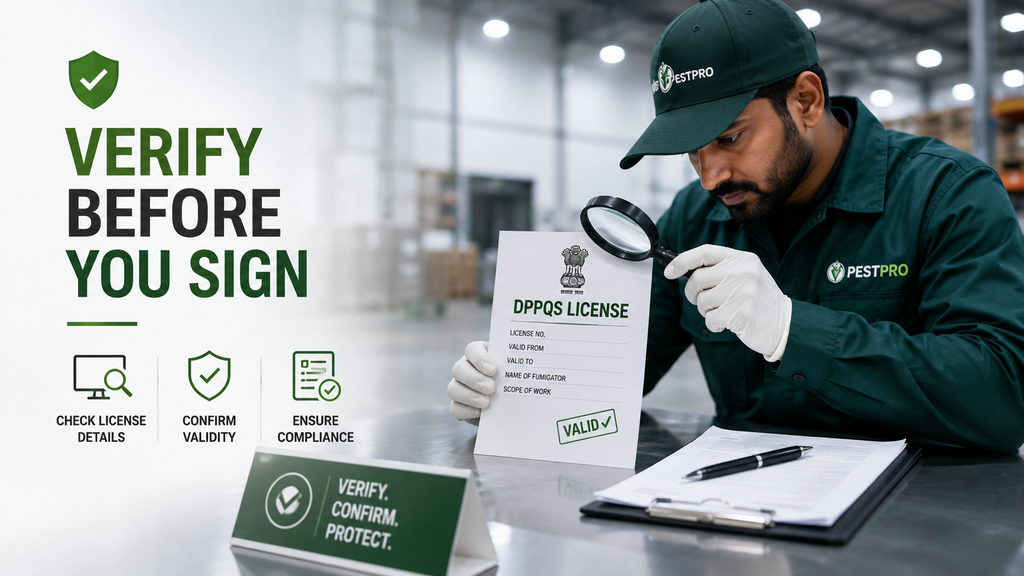
Request the operator's accreditation number directly, confirm which specific fumigant(s) it covers, and check that the accreditation is current rather than expired or under review. A vendor who hesitates to produce this on request, or who quotes a price before confirming which treatment your shipment actually requires, is a red flag worth pausing on.
The scale of what's being checked at the border makes this more than a formality. Between April 2019 and March 2024, India's plant quarantine system processed 6,43,885 import samples, finding 27,209 infested or infected — 13,998 with insects or mites, 2,147 with nematodes, and 10,102 with fungi or bacteria (Ministry of Agriculture and Farmers Welfare, Lok Sabha Unstarred Question No. 3707, retrieved 2026-07-21), eparlib.sansad.in).
Before You Sign: DPPQS Verification Checklist
- Accreditation number produced on request, not "will send later"
- Accreditation explicitly covers the specific fumigant (MB or phosphine)
- Accreditation status is current, not expired or under review
- Treatment matched to destination country's phytosanitary requirement
- Certificate format matches what customs at destination expects
DPPQS NSPM-22 Guidelines for Accreditation of Fumigation Agencies.
ISPM 15 wood packaging requirements → what the resulting stamp needs to show]
What Are the Red Flags of an Improperly Accredited Fumigator?
The clearest red flags: no accreditation number offered without prompting, a certificate referencing a fumigant type the operator hasn't demonstrated accreditation for, or pricing quoted before the commodity and destination requirements are even discussed.
We've had prospective clients switch to us mid-shipment after a previous vendor's certificate was rejected at a destination port over an accreditation mismatch. In every case, the accreditation gap was something the client could have caught with a single direct question before signing.
phosphine vs methyl bromide comparison → confirming which fumigant your shipment actually needs
Frequently Asked Questions
Who accredits fumigation operators in India?
The Plant Protection Adviser, under the Plant Quarantine (Import into India) Order, 2003, with DPPQS maintaining the accreditation standards (NSPM-22) that operators must meet.
Is one fumigation accreditation valid for all fumigant types?
No. Accreditation is treatment-specific — an operator accredited for aluminium phosphide isn't automatically accredited for methyl bromide, which follows a separate standard (NSPM-11).
What should I ask a fumigator before signing a contract?
Ask for their accreditation number, confirm it covers the specific fumigant needed for your shipment, and verify it's currently valid rather than expired.
What happens if I use an unaccredited fumigator?
The resulting certificate can be rejected at the destination port regardless of whether the fumigation was performed correctly, since the documentation trail no longer holds up to verification.
Where to Start
Before your next shipment, ask your current fumigator one direct question: what is your accreditation number, and does it cover this specific fumigant? book a compliance audit or site survey → PestPro India's audit-ready compliance service] if you're not confident in the answer.
Sources Cited
- DPPQS, Directorate of Plant Protection, Quarantine & Storage, retrieved 2026-07-21
- DPPQS, NSPM-22 Guidelines for Accreditation of Fumigation Agencies, retrieved 2026-07-21
- Ministry of Agriculture and Farmers Welfare, Government of India, Lok Sabha Unstarred Question No. 3707, retrieved 2026-07-21
- Image credit: Pixabay License (free for commercial use) — india-5890889