
Key Takeaways
- Bird netting closes off an open space so birds can't fly in at all; bird spikes cover a landing surface so birds can't perch there they solve different bird behaviors, not the same problem at different price points.
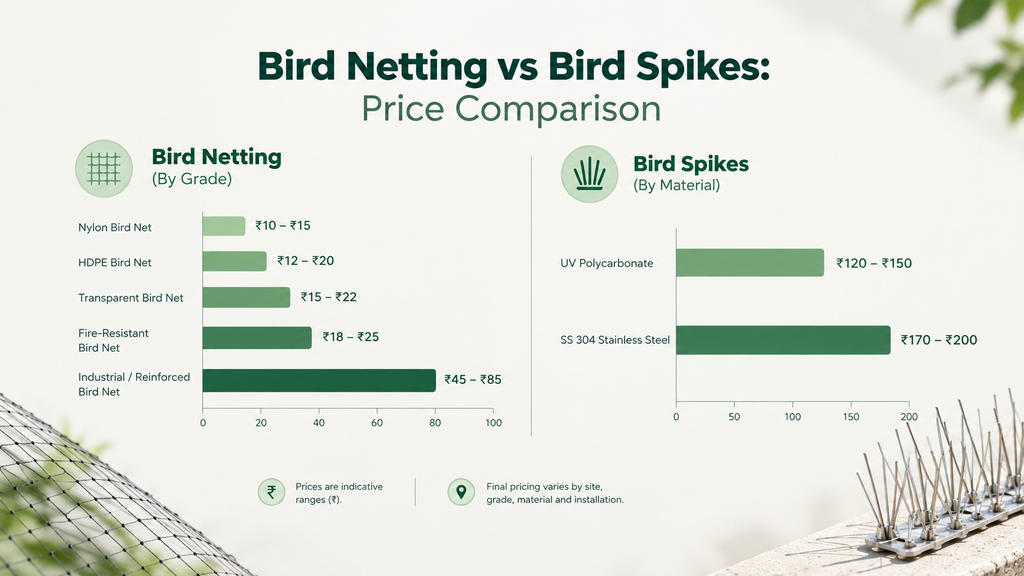
- Bird netting typically costs roughly ₹15–₹60 per sq ft depending on grade, plus ₹5–₹10/sq ft installation; bird spikes run roughly ₹15–₹55 per linear foot or piece depending on material.
- Stainless steel spikes cost more upfront but last over a decade without corrosion; polycarbonate spikes are cheaper but shorter-lived.
- Many properties genuinely need both netting on an open balcony face, spikes on an exposed ledge or AC unit the netting doesn't cover.
- Buying the cheaper option when your actual problem calls for the other one solves nothing — the comparison that matters isn't cost, it's which bird behavior you're dealing with.
Pigeons, crows, and mynas are the most common bird nuisance across Indian homes, balconies, and commercial buildings, and the two standard deterrents — netting and spikes — get shopped interchangeably far more often than they should be, because they don't actually do the same job.
Dealing with this pest at your property?
Get a same-day inspection and written quotation.
What Each Product Solves
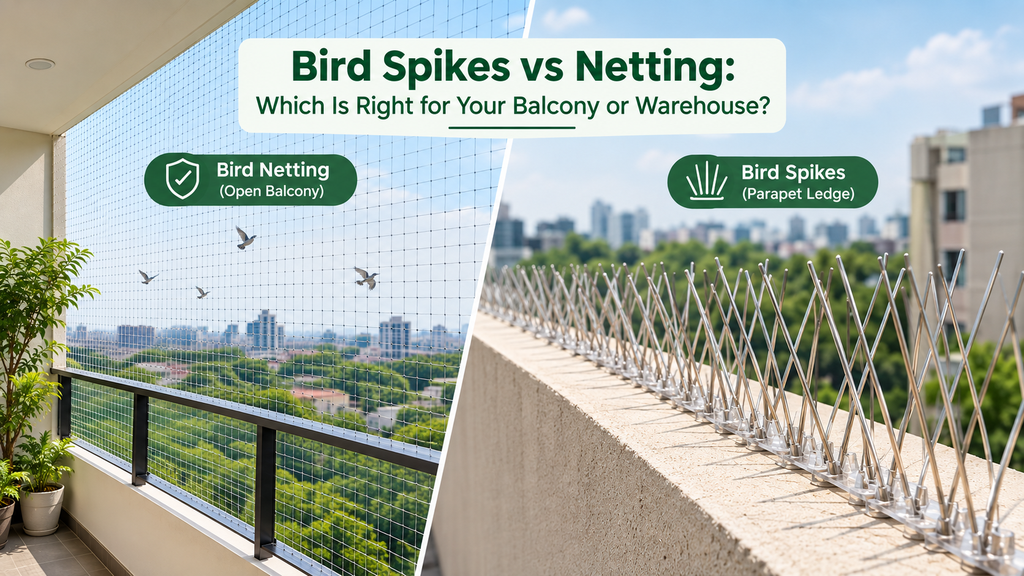
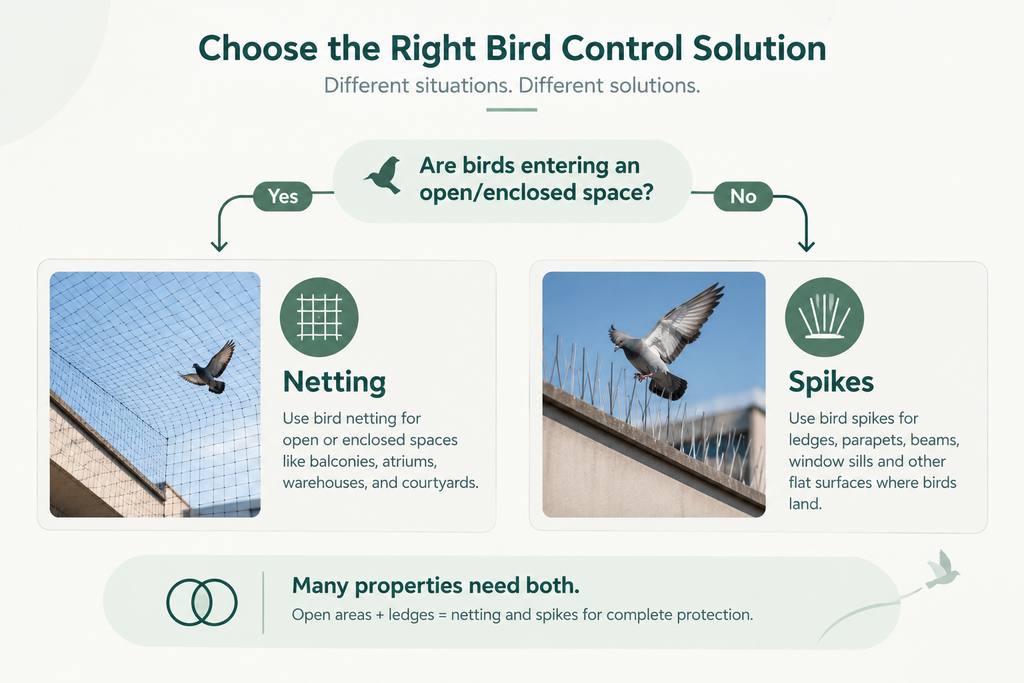
Bird netting is designed for open spaces it covers a balcony's open face so birds physically cannot fly into the enclosed area at all. Bird spikes are designed for landing surfaces they cover ledges, parapets, window sills, and similar flat perches so birds can't land there, without closing off the space itself (SecureHomeNets- Pigeon Net vs Bird Spikes). If pigeons are flying into and roosting inside your balcony, netting solves that. If crows or mynas are landing and fouling a parapet ledge or AC unit but not entering an enclosed space, spikes solve that netting would be the wrong product entirely, since there's no "opening" to close.
Cost Comparison
| Product | Grade/Material | Typical Price |
| Bird netting | Basic | ₹15 – ₹25/sq ft |
| Bird netting | Standard | ₹25 – ₹40/sq ft |
| Bird netting | Premium | ₹40 – ₹60/sq ft |
| Bird netting | Installation (add-on) | ₹5 – ₹10/sq ft |
| Bird spikes | Polycarbonate | Roughly ₹15 – ₹20 per foot/piece |
| Bird spikes | Stainless steel | Roughly ₹45 – ₹55 per piece |
These figures reflect published 2026 Indian market pricing across suppliers (NetnSpike / Networks Bird Net pricing context); (IndiaMART — Stainless Steel Bird Spikes); (TradeIndia — Polycarbonate Bird Spike Manufacturers). On a straight per-unit basis, spikes are typically cheaper than a full netting installation because they only cover specific ledge surfaces rather than an entire open face (Elite Bird Management — Cost Comparison: Spikes vs Netting) — but that's not a reason to default to spikes if your actual problem is an open balcony that needs closing off entirely.
Material Matters Within Each Category
For spikes specifically, stainless steel (commonly AISI 304 or 316 grade) costs more per piece upfront but lasts over a decade without corroding, while polycarbonate spikes are less expensive but have a shorter service life (Elite Bird Management). For a coastal or high-humidity setting, or anywhere spikes will be exposed to monsoon rain for years, stainless steel's corrosion resistance usually justifies the higher upfront cost. For a lower-exposure, budget-conscious installation, polycarbonate is a reasonable trade-off as long as you're planning to replace it on a shorter cycle. For netting, grade generally tracks mesh strength and UV/weather resistance — a premium net holds up longer against sun and rain exposure than a basic one, which matters more in a climate like Rajasthan's than it might elsewhere.
When You Need Both
Many apartments and commercial buildings need both products simultaneously — netting closing the open balcony face, and spikes covering a parapet ledge, AC unit top, or window sill that the netting doesn't reach (Networks Bird Net — Bird Netting vs Other Bird Control Methods). Before buying either product alone, walk the property and identify every surface birds are actually using — flying into an open space is a different surface than landing on a ledge, and treating only one while the other stays exposed means the bird problem continues from wherever you didn't cover.
This decision sits within a broader set of pest product choices — see our pest control products buying guide for how bird deterrents compare to fogging machines and anti-termite systems as a category, and our DIY vs professional pest control guide if you're unsure whether a self-install is appropriate for your situation versus hiring it out.
FAQ
Can I install bird spikes or netting myself?
Both are commonly sold as DIY-installable products, especially for straightforward balcony or ledge configurations. Complex installations — large warehouse eaves, multi-story facades — are usually better handled by a professional installer for both safety and coverage-quality reasons.
Do bird spikes actually hurt birds?
No — properly designed bird spikes are a deterrent, not a harm mechanism. They're spaced and angled to make landing uncomfortable or impossible, not to injure a bird that lands near them.
How long does bird netting typically last?
This depends heavily on grade and weather exposure — a premium, UV-resistant net in a well-installed setup can last several years, while a basic net in a harsh, sun-exposed installation may need replacement sooner.
Sources
- SecureHomeNets — Pigeon Net vs Bird Spikes: Which to Install and Where
- Elite Bird Management — Cost Comparison: Spikes for Birds vs. Netting and Other Bird Deterrents
- Networks Bird Net — Bird Netting vs. Other Bird Control Methods
- IndiaMART — Stainless Steel Bird Spikes Pricing
- TradeIndia — Polycarbonate Bird Spike Manufacturers & Prices