
Key Takeaways
- Methyl bromide is banned for general/non-quarantine use in India as of January 1, 2010, under Montreal Protocol commitments.
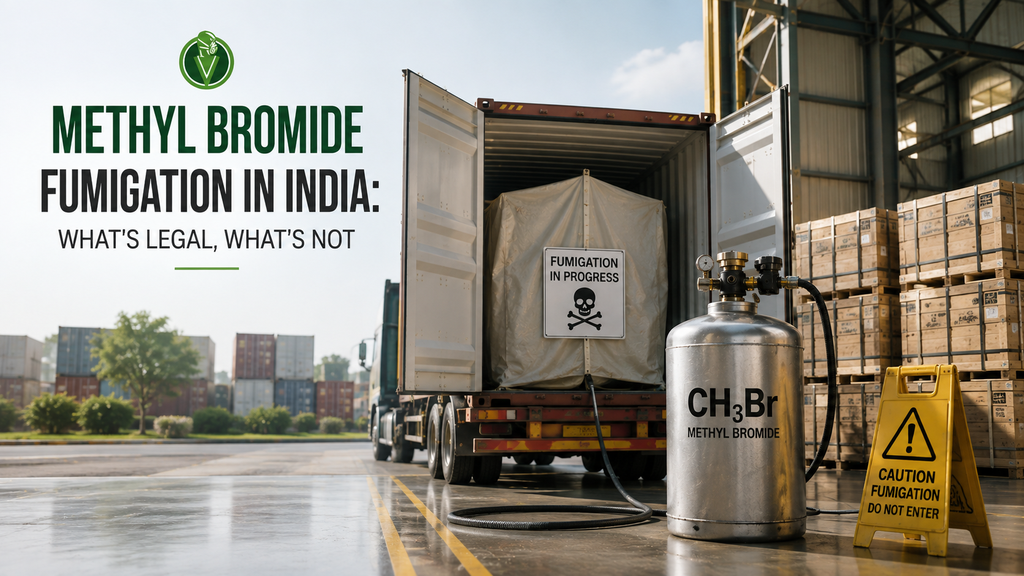
- It remains legal for quarantine and pre-shipment (QPS) treatments — the exact category most export fumigation falls into under Article 2H of the Montreal Protocol.
- A DPPQS-accredited operator, not just any fumigation company, must perform QPS treatments for the certificate to hold up at customs.
Why Is Methyl Bromide Both Banned and Legal in India?
Article 2H of the Montreal Protocol explicitly exempts methyl bromide used for quarantine and pre-shipment (QPS) treatments from the fumigant's general phase-out schedule (UNEP Ozone Secretariat, Critical-Use Exemptions for Methyl Bromide, retrieved 2026-07-21). India completed its phase-out of non-QPS controlled uses by January 1, 2010, with the Ozone Cell under the Ministry of Environment, Forest and Climate Change overseeing the transition (Mongabay India, The journey of phasing out ozone-depleting substances, retrieved 2026-07-21).
Dealing with this pest at your property?
Get a same-day inspection and written quotation.
That's the whole confusion in one sentence: the general ban is real and has been in effect for over a decade, but the QPS carve-out was never part of that phase-out to begin with. It isn't a loophole — it's a deliberate, internationally recognized exemption built into the treaty from the start.
What Counts as "Quarantine and Pre-Shipment" Use?
QPS use covers phytosanitary treatments required by an importing or exporting country before goods cross a border — most commonly wood packaging fumigation under ISPM 15, and treatment of stored grain, dried fruit, and other regulated commodities destined for international shipment (IPPC/UNEP, QPS Brochure, retrieved 2026-07-21).ippc.int.
The distinction that matters practically: if the treatment exists to satisfy a destination country's import requirement, it's almost certainly QPS. If it's routine domestic pest management with no cross-border phytosanitary trigger, it's the use category that's been banned since 2010.
Exporters occasionally ask us to use methyl bromide for a domestic warehouse issue unrelated to any shipment. We can't — and won't — treat that as a QPS case just because the chemical happens to be on hand for export work. The exemption is use-specific, not chemical-specific.
Who Is Authorized to Perform Methyl Bromide Fumigation?
Only fumigation operators accredited by the Plant Protection Adviser under the Plant Quarantine (Import into India) Order, 2003 may legally perform methyl bromide QPS treatments, per DPPQS's NSPM-11 Quarantine Treatment Standard (DPPQS/Phytosanitary Solutions, NSPM-11, retrieved 2026-07-21).
That accreditation requirement is the real compliance risk point — not the chemical itself. A fumigation vendor using methyl bromide without valid accreditation invalidates the treatment's phytosanitary standing regardless of whether the fumigation was performed correctly.
how to verify a DPPQS fumigator license → step-by-step accreditation verification
phosphine vs methyl bromide comparison → which fumigant your shipment actually needs.
Is Methyl Bromide the Only Option for QPS Treatment?
No — phosphine is a widely used, non-ozone-depleting alternative for many QPS applications, though it requires a substantially longer exposure and aeration period than methyl bromide's roughly 24-hour treatment window (ResearchGate, Phosphine as methyl bromide alternative for QPS treatment of food grains in India, retrieved 2026-07-21).
Which one applies to your shipment depends on the commodity, the destination country's specific requirement, and your shipping timeline — not a blanket preference either way.
Frequently Asked Questions
Is methyl bromide banned in India?
It's banned for general/non-quarantine agricultural use as of January 1, 2010, but remains legal for quarantine and pre-shipment (QPS) treatments under Article 2H of the Montreal Protocol.
What is QPS treatment?
Quarantine and pre-shipment treatment refers to phytosanitary fumigation required by an importing or exporting country before goods cross a border — the exemption category covering most Indian export fumigation.
Can any pest control company legally use methyl bromide?
No — only operators accredited by the Plant Protection Adviser under the Plant Quarantine (Import into India) Order, 2003, following DPPQS's NSPM-11 standard, may perform methyl bromide QPS fumigation.
Is there a non-ozone-depleting alternative to methyl bromide?
Yes, phosphine is a common alternative for many QPS applications, though it requires a much longer exposure and aeration period — often 8 or more days compared to methyl bromide's roughly 24-hour cycle.
Where to Start
If your fumigation vendor can't clearly explain the QPS exemption or produce a DPPQS accreditation number, that's the first thing to fix — not the chemical choice.
[ book a compliance audit or site survey → PestPro India's audit-ready compliance service] to confirm your current fumigation program is properly licensed.
Sources cited:
UNEP Ozone Secretariat, Critical-Use Exemptions for Methyl Bromide, retrieved 2026-07-21
Mongabay India, The journey of phasing out ozone-depleting substances, 2025, retrieved 2026-07-21
IPPC/UNEP, QPS Brochure, retrieved 2026-07-21
DPPQS, NSPM-11 Quarantine Treatment - Methyl Bromide Fumigation Standard, retrieved 2026-07-21
ResearchGate, Phosphine as methyl bromide alternative for QPS treatment of food grains in India, retrieved 2026-07-21
Image credit: Pixabay License (free for commercial use) — bottles-1724459