
Key Takeaways
- FSSAI Schedule 4 requires a documented, continuous pest control program, not periodic treatment alone (FSSAI, Schedule 4 Part II).
- Pest-control records must be retained for at least one year or the product's shelf life, whichever is longer.
- Premises can't be sited in, or adjacent to, pest-infestation-prone areas — a requirement that predates any treatment schedule.
Dealing with this pest at your property?
Get a same-day inspection and written quotation.
What Does FSSAI Schedule 4 Actually Require for Pest Control?
FSSAI's Schedule 4, Part II — General Hygienic and Sanitary Practices for Food Business Operators — requires a documented cleaning and sanitation program with defined areas, frequency, and procedures, alongside a continuous and effective pest control program covering routine premises checks for infestation signs (FSSAI, Schedule 4 Part II, retrieved 2026-07-21).
That word "continuous" is doing a lot of work. It isn't satisfied by a quarterly visit alone — it implies an ongoing monitoring system between treatments, which is exactly where most facilities fall short. A technician visiting four times a year without a logging system in between isn't running a continuous program; they're running four disconnected visits.

What Are the Specific Schedule 4 Requirements You Need to Document?
Schedule 4 requires five specific elements auditors check for directly: sealed access points (holes, drains, and gaps sealed against entry), a documented cleaning/sanitation schedule, a continuous pest monitoring and control program, retained records, and premises sited away from infestation-prone areas (FSSAI Schedule 4, retrieved 2026-07-21).
From our own audit support work: Across the FSSAI compliance audits PestPro India has supported for Jaipur and Rajasthan food processors this year, the single most common gap wasn't missing treatment — it was missing evidence that access points were checked and sealed between scheduled visits.
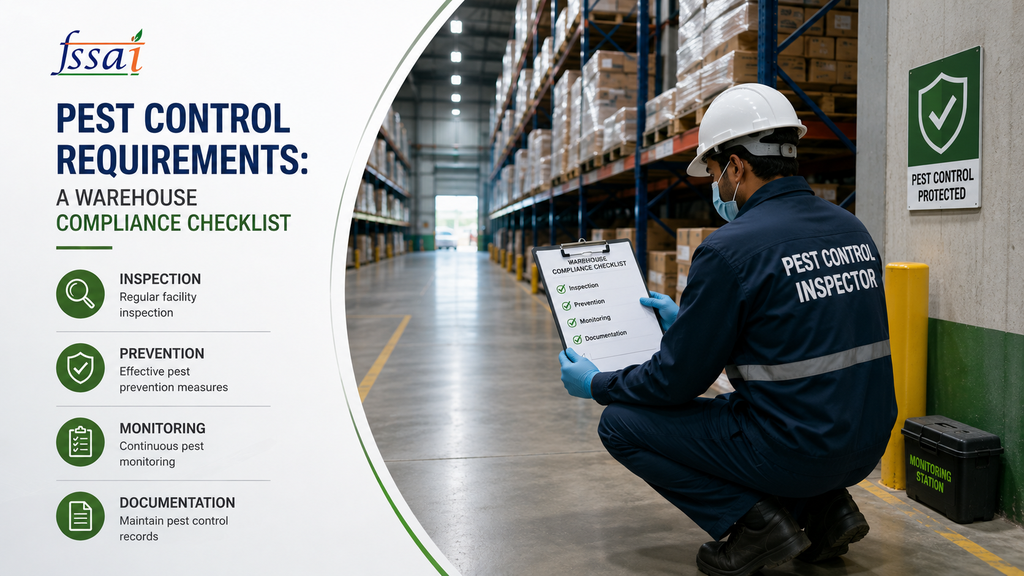
Here's the practical checklist we walk clients through before an audit:
- Documented cleaning/sanitation schedule with named areas and frequency
- Pest monitoring log showing routine checks, not just treatment visits
- Sealed entry points: drains, wall gaps, door thresholds, ventilation screens
- Chemical usage records with technician name and signature
- Corrective-action documentation for any pest sighting
- Records retained for 1 year or product shelf life, whichever is longer
How Long Must You Retain Pest Control Records?
Records must be retained for at least one year or the shelf life of the product, whichever is longer — a requirement that surprises facility managers who assume a standard 90-day or annual retention window applies universally (FSSAI Schedule 4, retrieved 2026-07-21).
Why does this matter beyond the audit itself? Because a recall investigation or customer complaint can reach back well past a year for long-shelf-life products, and an incomplete record trail at that point is functionally the same as no record at all.
What Happens If Your Premises Are Near a Pest-Infestation-Prone Area?
Schedule 4 requires that food premises not be located in, or immediately adjacent to, areas prone to pest infestation — a siting requirement that exists independently of whatever treatment program you run once operational (FSSAI Schedule 4, retrieved 2026-07-21).
This siting clause is easy to overlook because it applies before you've booked a single pest-control visit — it's a facility-selection factor, not a service-vendor factor. Facilities that later discover they're sited near an infestation-prone zone often need a materially more aggressive ongoing program to compensate, not just a compliant one.
What Should Your Pest-Proofing Actually Cover?
Effective pest-proofing focuses on physical entry points — sealed drains, gap-free wall and floor junctions, self-closing doors, and screened ventilation — because Schedule 4's continuous-program requirement is judged partly on whether entry points stay sealed between technician visits, not just whether chemical treatment occurred.
Facility managers often assume the chemical treatment schedule is the primary compliance signal. In practice, auditors weigh physical pest-proofing just as heavily, because it demonstrates prevention rather than reaction.
Frequently Asked Questions
Does FSSAI require a specific pest control frequency?
Schedule 4 requires a "continuous and effective" program rather than mandating an exact visit frequency — the standard is judged on documented monitoring and prompt corrective action, not a fixed number of annual visits.
How long do I need to keep pest control records?
At least one year, or the shelf life of your product if longer — whichever period is greater, per FSSAI Schedule 4 Part II.
Can my facility fail an audit even with a clean pest record?
Yes — Schedule 4 also evaluates siting (not being near infestation-prone areas) and sealed access points independently of your treatment log, so a clean treatment record alone doesn't guarantee compliance.
What's the difference between pest-proofing and pest control?
Pest-proofing covers physical prevention — sealed entry points, screens, drains — while pest control covers active treatment. FSSAI Schedule 4 requires both, and auditors check them separately.
Where to Start
If you're preparing for an FSSAI audit, start with the gap our own client data shows most often: documented checks between scheduled treatment visits, not the treatment itself. book a compliance audit or site survey → PestPro India's audit-ready compliance service] before your inspection date, not after.
Sources cited:
- FSSAI, Schedule 4 Part II — General Hygienic and Sanitary Practices, retrieved 2026-07-21
- FSSAI, Hygiene Requirements, retrieved 2026-07-21
- Food Safety Helpline, FSSAI Schedule 4 Part II summary, retrieved 2026-07-21
- Image credit: Pixabay License (free for commercial use) — storage-warehouse-1553550