
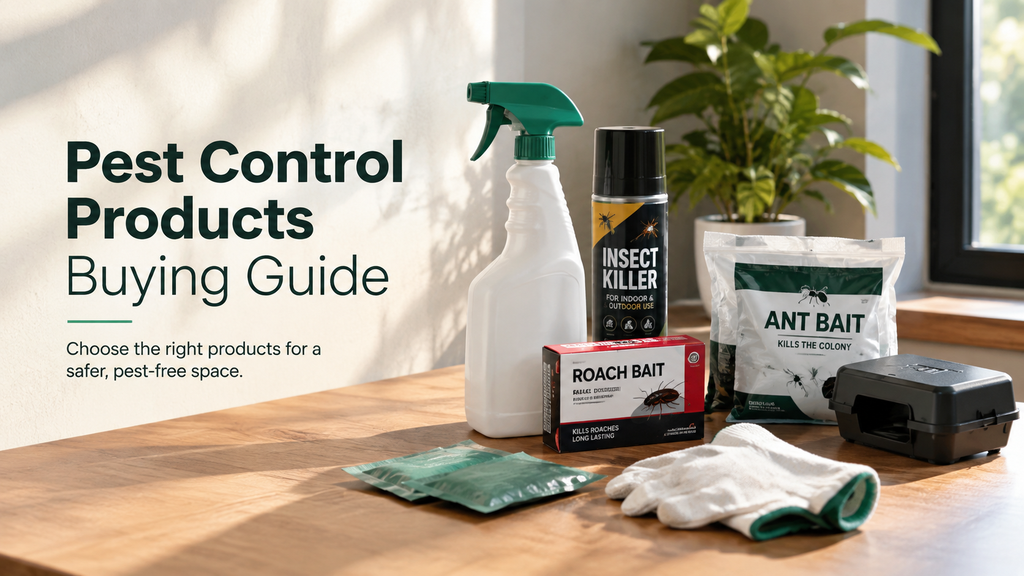
Pest Control Products Buying Guide: What You Actually Need
Walk into any hardware store or browse any pest control products page and you'll find fogging machines, termiticide piping kits, bird spikes, sprays, and traps sitting side by side, all implicitly promising to solve "your pest problem". They don't solve the same problem. This guide breaks down what each major product category actually does, what it costs, and when the right answer is a professional rather than a product at all.
Dealing with this pest at your property?
Get a same-day inspection and written quotation.
Key Takeaways
- Most pest control product purchases fail for the same reason: the product was matched to the pest's name, not to the actual scale and location of the problem.
- Fogging machines, anti-termite piping, and bird deterrents solve fundamentally different problems and are not substitutes for each other.
- DIY products work well for small, contained, early-stage problems; anything structural, recurring, or spread across a property tends to need a professional assessment first.
- Pre-construction products (like anti-termite piping) are dramatically cheaper to install before a slab is poured than to retrofit later — this is the one category where timing matters more than the product itself.
- Buying the wrong product isn't just wasted money — it can mask a growing problem long enough for it to get more expensive to fix.
Walk into any hardware store or browse any pest control products page and you'll find fogging machines, termiticide piping kits, bird spikes, sprays, and traps sitting side by side, all implicitly promising to solve "your pest problem." They don't solve the same problem. This guide breaks down what each major product category actually does, what it costs, and — just as importantly — when the right answer is a professional rather than a product at all.
How to Think About This Before You Buy Anything
Before picking a category, answer three questions: What is the pest (or pests)? Where is the problem — a single room, an entire structure, an open-air balcony, a warehouse? And is this preventive (nothing's wrong yet, you're building or protecting) or reactive (there's already an active infestation)? A mosquito problem in a single room and a mosquito problem across a warehouse floor call for completely different equipment classes, and a termite problem discovered after the house is built calls for a different treatment approach than one addressed before the foundation is poured. Getting this framing right before comparing products is what actually determines whether the purchase solves the problem.
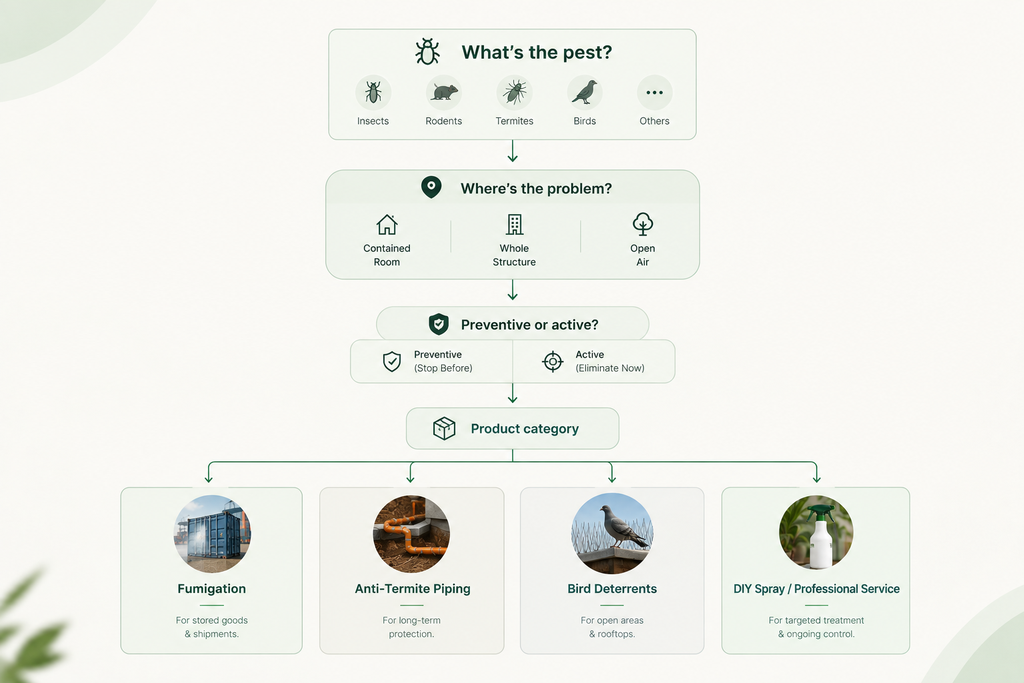
The Four Product Categories, at a Glance
| Category | Solves | Best For | Typical Cost Range |
| Fogging machines (ULV/thermal) | Flying and crawling insects across open or enclosed spaces | Warehouses, gardens, mosquito-prone outdoor areas, commercial spaces | Equipment: a few thousand to tens of thousands of rupees depending on type; per-treatment cost is separate |
| Anti-termite piping systems | Subterranean termite entry through the foundation | New construction, before the slab is poured | Roughly ₹6–₹25 per sq ft of plinth area, depending on provider and treatment scope |
| Bird spikes & netting | Birds landing on ledges or entering open balconies | Balconies, parapets, warehouse eaves, AC units | Netting: roughly ₹15–₹60/sq ft plus installation; spikes: roughly ₹15–₹55 per linear foot depending on material |
| DIY sprays, baits, traps | Small, contained, early-stage infestations | A single room, a handful of visible pests, prevention between professional visits | Generally the lowest upfront cost, but limited in scope and duration |
See Best Fogging Machines for Pest Control in India (2026), Anti-Termite Piping System: How It Works and What It Costs, and Bird Spikes vs Netting: Which Is Right for Your Balcony or Warehouse for the full breakdown on each category.
Fogging Machines: When You Actually Need One
Fogging machines exist to treat flying and crawling insects — mosquitoes, flies — across a space too large or too open for a spot treatment to reach effectively. There are two main types: ULV (Ultra Low Volume) cold foggers, which use air pressure rather than heat to disperse a fine mist, and thermal foggers, which vaporize the solution using heat (Solutions Stores — ULV Foggers). ULV units are generally the better fit for indoor and semi-enclosed commercial spaces because they don't rely on heat, while thermal foggers tend to produce a denser, more visible fog often used outdoors for mosquito control over larger areas. If your actual problem is a handful of mosquitoes in one room, a fogging machine is overkill — a DIY spray or plug-in repellent solves that faster and cheaper. Fogging earns its cost when the space is large, open, or commercial in scale. Full buying guidance, including specific use cases and price bands, is in our dedicated fogging machine guide.
Anti-Termite Piping: The One Product Where Timing Is Everything
An anti-termite piping (reticulation) system is a network of perforated PVC pipes installed under a building's foundation before the slab is poured, allowing termiticide to be injected and refreshed periodically without excavation (Total Services India — Anti-Termite Piping System). This is fundamentally a pre-construction product — it has to go in before the flooring is laid, which is exactly why it's cheaper and more effective than almost any post-construction alternative: pre-construction treatment can run roughly ₹6–₹10 per sq ft versus post-construction treatment that needs to work around an already-finished structure (HomeTriangle — Termite Control Cost in India 2026). If your home or facility is already built, this specific product isn't an option anymore — see Pre- vs Post-Construction Termite Treatment: Which Is Right? for what does work after the fact. If you're still at the planning or foundation stage, this is the single highest-value pest investment you'll make on the project. Full detail in our anti-termite piping system guide.
Bird Spikes and Netting: Two Different Problems
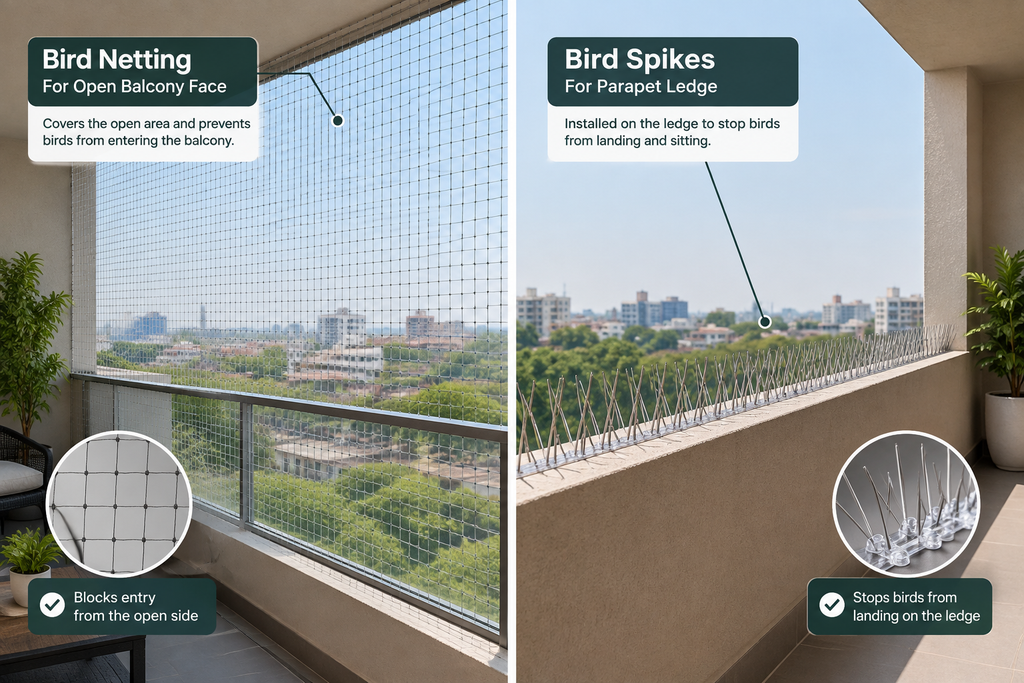
Bird spikes and bird netting get bought interchangeably far too often, and they solve different bird behaviors. Netting closes off an open space so birds can't fly in at all — the right fit for an open balcony. Spikes cover a landing surface — a ledge, a parapet, a window sill — so birds can't perch there, without closing off the space itself (SecureHomeNets — Pigeon Net vs Bird Spikes). Many apartments and commercial buildings genuinely need both: netting on the open balcony face, spikes along an exposed AC ledge or parapet the netting doesn't cover. Buying only one when your property needs both is the most common mistake in this category. Full cost breakdown and material comparison in our bird spikes vs netting guide.
DIY Products vs a Professional: The Line That Actually Matters
DIY sprays, gel baits, and traps are genuinely useful — for the right scope of problem. They tend to work best on small, visible, early-stage infestations, where the goal is knocking down what you can already see (Terminix — Comparing Professional Pest Control vs DIY). Where DIY consistently falls short is anything structural (termites inside a wall), anything with a hidden nest or colony (most cockroach and rodent problems), or anything that keeps coming back after treatment — in those cases, a store-bought product usually knocks down visible activity temporarily without addressing the source, and the underlying problem keeps growing while it looks handled (Accurate Pest Management — DIY vs Professional Services). There's also a real safety dimension: products sold for general household use are formulated and labeled for that context, and misuse — wrong concentration, wrong location, wrong frequency — is a more common risk with untrained DIY application than most people assume (Kingstowne Lawn — Why Professional Pest Control Is Safer Than DIY). India's Insecticides Act, 1968 permits household use of insecticides for one's own home, but requires products to be labeled for their intended use (household vs. agricultural) — using an agricultural-labeled product indoors is a genuine safety issue, not just a technicality (India Code — Insecticides Act, 1968). Full breakdown of exactly where that line sits in our DIY vs professional pest control guide.
A Simple Rule of Thumb
If you can see the entire scope of the problem with your own eyes — a few ants on a countertop, a single mosquito-prone room — a targeted DIY product is a reasonable first move. If the scope is uncertain, structural, recurring, or spread across more than one room or the whole property, that uncertainty itself is the signal to bring in a professional assessment before spending on any product. An assessment costs far less than buying the wrong equipment twice.
FAQ
Can I use professional-grade fogging machines or termiticide myself?
Some ULV fogging equipment is sold to the general public, but professional-strength termiticides and certain fumigants are restricted to licensed applicators under India's Insecticides Act. Always check a product's label for household-use approval before applying it yourself.
Is a DIY product ever a bad idea even for a small problem?
Yes, if the "small" visible problem is actually the surface of something larger — a few ants near a wall, for instance, can indicate a nest inside the wall that a surface spray won't reach. If a DIY treatment doesn't resolve the problem within a reasonable window, that's the signal to escalate rather than reapply.
Do I need to buy anti-termite piping if my property is already built?
No — that specific product only installs during construction, before the slab is poured. For an existing structure, post-construction chemical treatment or a termite reticulation retrofit (a different, more invasive process) are the relevant alternatives — see our pillar guide to termite control in Rajasthan for that comparison.
Sources
- Solutions Stores — The Best Pesticide ULV Foggers
- Total Services India — Anti-Termite Piping System
- HomeTriangle — Termite Control Cost in India 2026
- SecureHomeNets — Pigeon Net vs Bird Spikes: Which to Install and Where
- Terminix — Comparing Professional Pest Control vs DIY
- Accurate Pest Management — DIY Pest Control vs. Professional Services
- Kingstowne Lawn — 3 Reasons Why Professional Pest Control Is Safer Than DIY
- India Code — The Insecticides Act, 1968 (official text)