
When managing large-scale commercial facilities, manufacturing units, or export logistics, standard pest control methods like liquid sprays, gels, or baits often fall short. Deep-seated infestations within bulk raw materials, grain storage elevators, porous wooden packaging, or tightly packed shipping containers require a more sophisticated, scientific approach.
This is where Industrial Fumigation becomes an absolute necessity.
Unlike conventional surface treatments, fumigation is a highly specialized legal and scientific process engineered to eliminate 100% of target pests through absolute spatial penetration. Below, we break down exactly what fumigation entails, the science behind its mechanics, and why it is the gold standard for global bio-security compliance.
What Exactly is Fumigation?
At its core, Fumigation is a method of pest management where a chemical compound is deployed completely in a gaseous state to suffocate or lethal-dose target pests within an airtight enclosed space.
The most critical distinction to understand is that fumigation is not fogging, misting, or smoke generation. Smoke and mist consist of tiny suspended liquid droplets or solid particles that settle on surfaces but cannot penetrate dense materials. A true fumigant operates at a molecular level as a pure gas. Because gas molecules are smaller and highly diffusible, they can penetrate deep into porous substrates—such as raw timber, tightly packed grain sacks, or hidden structural cracks—where liquid sprays can never reach.
The Core Scientific Metrics of a Successful Treatment
Fumigation is a highly calculated chemical process. The terminal effectiveness of any operation is governed strictly by three interdependent variable metrics:
- Dosage Calculation: The exact volumetric amount of gas introduced, calculated carefully against the total cubic space of the sealed enclosure, rather than just surface floor area.
- Substrate Temperature: Temperature directly controls the respiration rate of insects and the expansion velocity of the gas. If temperatures are too low, the exposure timeline must be heavily adjusted.
- Exposure Duration: The precise timeline the gas must remain locked inside the airtight seal to ensure it penetrates to the deepest core of the commodities and terminates all life stages of the pest (including eggs, larvae, pupae, and adults).
The Standard Structural Phases of an Industrial Fumigation Operation
A professional, government-compliant fumigation operation follows four strict procedural phases to guarantee both maximum target kill rates and complete site safety:
Phase 1: Airtight Volumetric Sealing (Gas Retention)
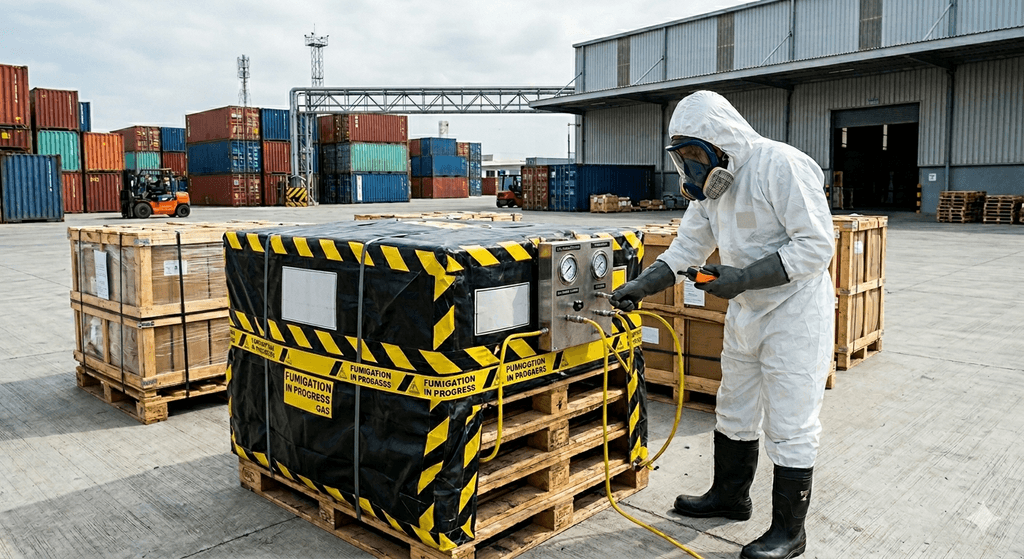
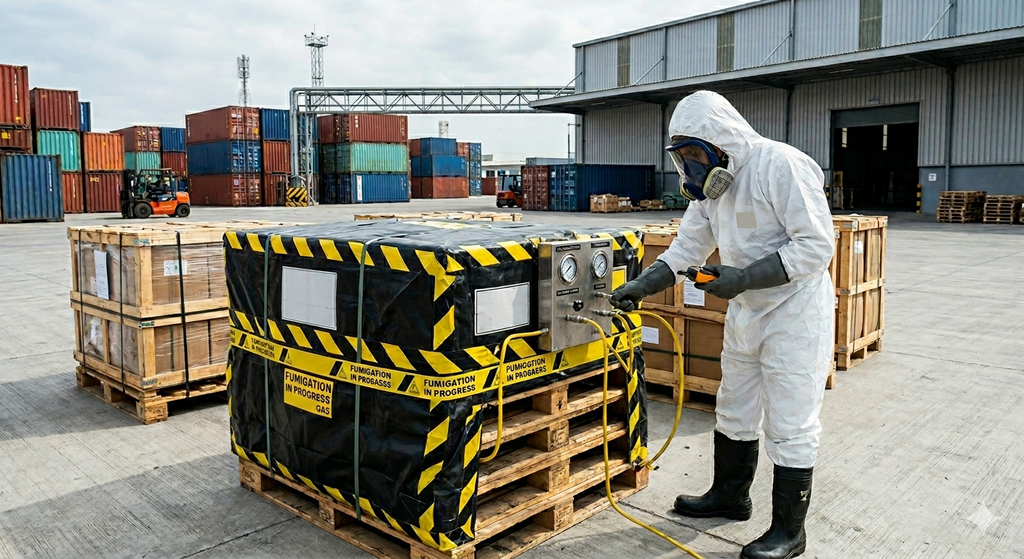
Before any gas can be introduced, the target area—whether it is a standard 20ft/40ft shipping container, an entire manufacturing warehouse grid, or a stack of wooden pallets—must be made 100% airtight. This is achieved using high-density, gas-retention tarpaulin sheets, heavy-duty masking materials, and specialized sealing tapes. If there is even a minor gas leak, the volumetric pressure drops, resulting in a failed compliance treatment.
Phase 2: Controlled Gas Injection & Monitoring
Once the pressure testing confirms a perfect seal, the calculated volume of certified fumigant is introduced through specialized high-pressure lines. Throughout the required exposure window (which can range from 24 to 48+ hours), specialized sensors monitor the internal gas concentration levels to ensure they stay above the lethal compliance threshold.
Phase 3: Forced Aeration & Degassing
After the terminal exposure timeline is achieved, the degassing phase begins. Certified technical teams open the sealed enclosures using controlled aeration equipment, venting the trapped gas safely into the atmosphere. The space remains restricted until gas monitoring devices confirm that internal levels have reached absolute zero parts per million (0 PPM).
Phase 4: Clear-Level Certification
Once the area is verified as 100% gas-free and completely safe for human re-entry, an official, audit-ready compliance certificate is instantly generated. This documentation acts as legal proof for border authorities, customs, and third-party safety auditors.
Primary Specialized Domain Verticals
Industrial fumigation scales across several distinct commercial applications depending on the supply chain node:
- Cargo Container Fumigation: Securing shipping containers directly at manufacturing yards or dry docks prior to international transit to eliminate systemic liability.
- ISPM-15 Standard Pallet Fumigation: Mandatory phytosanitary processing for raw Wood Packaging Material (WPM) such as wooden crates, boxes, and dunnage to prevent the global transmission of wood-boring pests.
- Warehouse & Space Fumigation: Full-scale facility sealing for major raw material depots, processing plants, and bulk warehouses to protect large-scale business assets.
- In-Transit / Ship Hold Fumigation: Specialized gas application executed inside the closed cargo holds of maritime vessels to safeguard international loose commodities while traveling across oceans.
Why Is Industrial Fumigation So Crucial?
1. Eliminates Multi-Million Commercial Rejections
International border customs and quarantine agencies have a strict zero-tolerance policy for invasive pests. Discovering even a single live wood borer or stored product beetle inside an international shipment can lead to immediate border seizure, expensive container blacklisting, or the complete destruction of your high-value export cargo at your own expense.
2. Deep Structural and Material Penetration
Pests like termites, powder-post beetles, and wood borers lay their eggs deep inside timber cores or within heavy machinery gaps. Surface sprays cannot reach these areas. Because gas expands uniformly to occupy all accessible volume, it penetrates dense materials completely, stopping